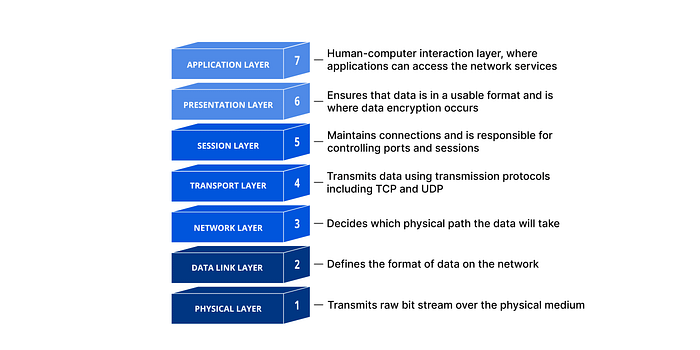
The OSI (Open Systems Interconnection) model is a conceptual framework that standardizes the functions of a telecommunication or computing system into seven abstraction layers. Each layer has a specific role in managing aspects like hardware, addressing, routing, and application-level interactions. The OSI model is used to understand and design network architectures, and it helps in troubleshooting network communication issues.
Osi model is great understanding of network but it is very challenging to use in practice. this is why we using TCP/IP model.
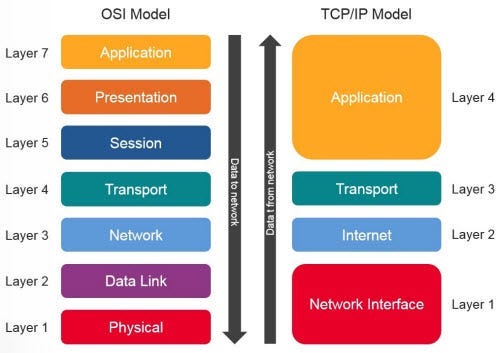
Top three layers are combined into one layer and bottommost two layers are combined into one layer. so instead of having seven layer we have four layers model and it is quiet easy to practice. Because we are using this.
Protocols : TCP/UDP/IP
A protocol is a set of rules that defines how data is transmitted and received between devices in a network. It ensures standardized communication, allowing different systems to understand and interact with each other. Examples include TCP/IP, HTTP, and SMTP
i. TCP (Transmission Control Protocol):
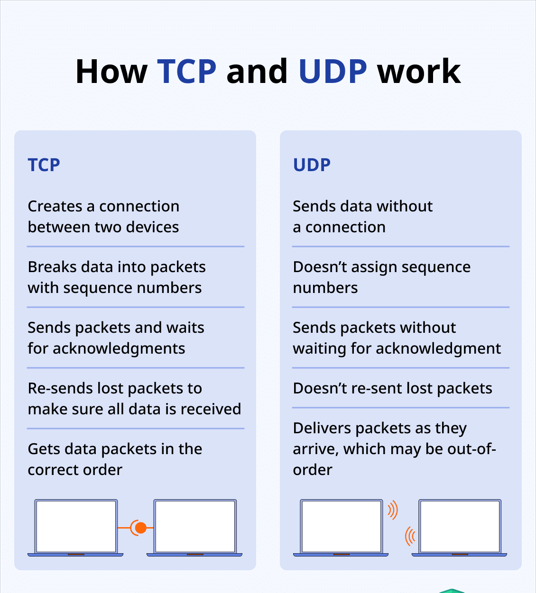
Description: TCP operates at the transport layer of the OSI model. It establishes a connection between two devices before data exchange, ensuring reliable and ordered delivery of information.
Functionality: It breaks data into packets, assigns sequence numbers, and uses acknowledgment messages to guarantee delivery. It’s connection-oriented, meaning it sets up, maintains, and terminates a connection for data exchange.
ii. UDP (User Datagram Protocol):
Description: Also operating at the transport layer, UDP is a connectionless protocol that offers minimal services. It’s like a ‘fire and forget’ approach for data transmission.
Functionality: It sends data without establishing a connection, providing low latency communication. However, it doesn’t guarantee delivery or order, making it suitable for real-time applications like video streaming or online gaming.